
If you’ve been living with a bipolar diagnosis for years—or even decades—and you’ve been told you’ll need medication for the rest of your life, this story might completely change your perspective.
One of our clients, a 64-year-old man we’ll call Gary to protect his privacy, had carried a bipolar diagnosis for 23 years. For over two decades, he’d been managing severe depression and anxiety with multiple psychiatric medications. His symptoms had become so overwhelming that at one point, he’d attempted to take his own life.
When he came to us at the end of October, he was taking 1 milligram of Xanax as needed, 600 milligrams of lithium carbonate twice daily, and 125 milligrams of Lamictal every day. Twenty-three years. The same diagnosis. The same medications. Just managing, never truly healing.
But here’s the question nobody had ever asked: What if his “bipolar disorder” wasn’t actually a lifelong psychiatric condition? What if it were a measurable brain chemistry imbalance—something that could be identified with testing, addressed with targeted treatment, and actually corrected?
In just eight weeks, we proved it was exactly that.
When this man first came to see us, his symptom sheet told a story of years of struggling.
Gary’s worst symptoms were severe anxiety and depression—the kind that had become so unbearable, he’d attempted to take his own life. He was battling significant fatigue and a complete inability to focus. These weren’t minor inconveniences. These were symptoms that had stolen 23 years of his life.
But his mental health wasn’t the only thing suffering. He’d also been dealing with significant gut issues for many, many years—soft, unformed stools, constant bloating, and persistent stomach pain. He’d seen doctors about these digestive problems with absolutely no resolution.
On top of everything else, he couldn’t sleep, which only made the rest of his symptoms worse.
Here was someone who had been managing symptoms—not healing—for over two decades. He’d been told he had bipolar disorder, given medications to control what he was experiencing, and that was supposed to be the answer. But he was still suffering. Still struggling. Still far from well.

When Gary started working with us, we took a completely different approach. We didn’t just accept the bipolar diagnosis and try to manage symptoms better. We investigated what was actually happening in his brain and body.
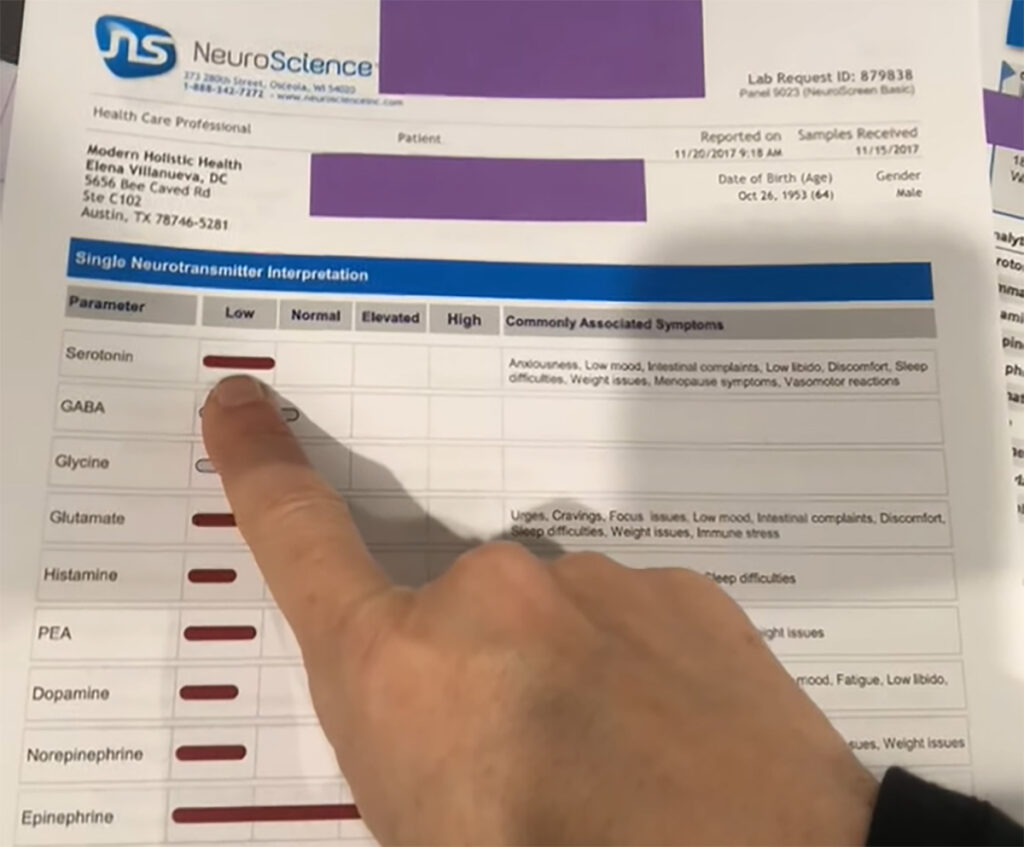
We ran comprehensive neurotransmitter testing to see exactly what his brain chemistry looked like. We also did genetic testing and blood work because we needed to understand the whole picture. And here’s something critical: we knew we had to work on his gut as well, because most of your neurotransmitters are actually made in your gut. You can’t take a single-system approach to brain chemistry issues. You have to look at the whole body holistically.
The neurotransmitter results came back in November, and when we looked at them, we could see exactly what was wrong.
Gary’s serotonin was too low. His GABA, even though it was technically within the normal range, was on the low end for him and wasn’t helping to counterbalance the other imbalances. His dopamine was too low. His norepinephrine was too low. But his epinephrine was too high—meaning he was stuck in fight-or-flight mode, experiencing constant anxiety and just not feeling well.
These weren’t vague symptoms; they were measurable, specific imbalances that we could see on paper.
Based on all of his genetic data, neurotransmitter data, and blood work, we put him on a personalized protocol designed to correct these specific imbalances and to heal his gut.
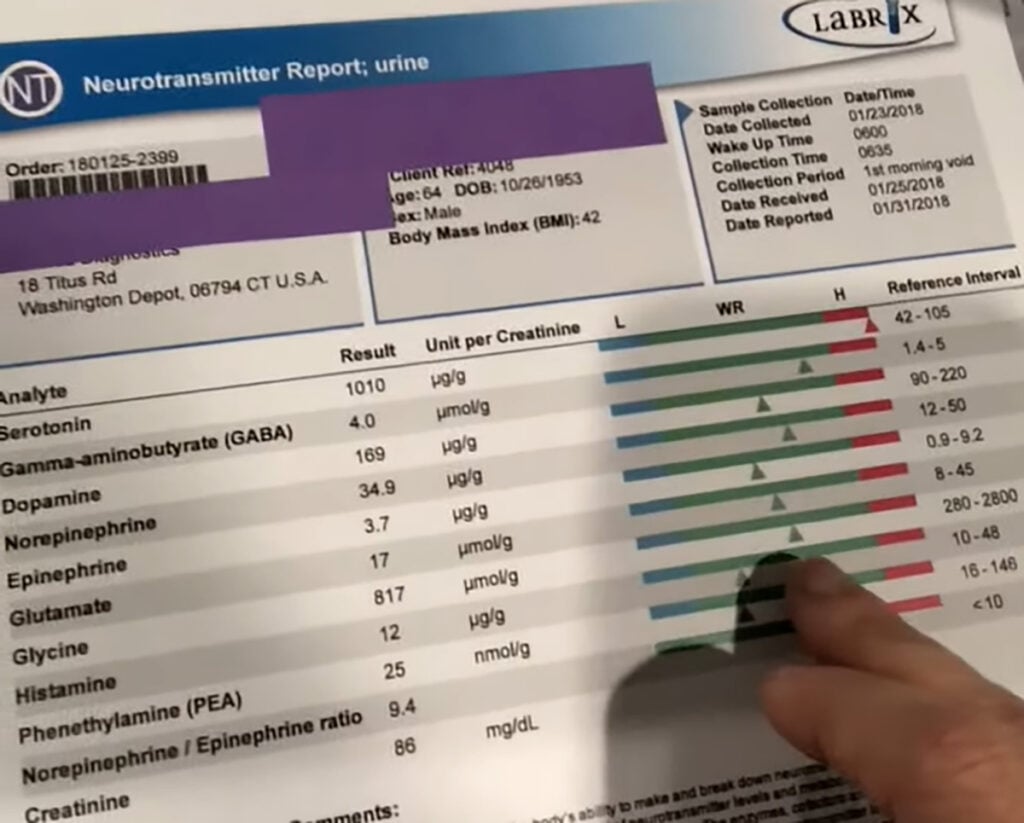
Here’s where things get exciting. After just eight weeks on the protocol, we retested his neurotransmitters, and the transformation was remarkable.
His PEA, which had been out of range, was now within normal limits. His histamine, which had been really, really low, was now right in the middle of the optimal range where it should be. His glycine? In range. His glutamate? In range.
We were able to bring his epinephrine—the neurotransmitter that had kept him trapped in constant fight-or-flight mode—down into a healthy range. His norepinephrine, which had been too low, was back where it needed to be. His dopamine, which had been extremely low, now looked wonderful.
His GABA was nicely elevated. His serotonin was also high—slightly above the normal range. But here’s what matters most: he was completely asymptomatic. He wasn’t experiencing any negative effects from the slightly elevated serotonin. In fact, Gary was feeling great.
This is always how the process works. We can’t correct every neurotransmitter imbalance in one shot—it’s a gradual process that takes time and careful monitoring. That’s why we retest every eight to twelve weeks, depending on how severe the case is. In his situation, we needed to prioritize getting his primary neurotransmitters up first, which would then create a ripple effect and help bring up some of the others that were lagging behind.
Now that we have this new data, we can refine Gary’s protocol to bring that serotonin down to the optimal range. But the bottom line is this: he’s asymptomatic. He’s feeling great. And after 23 years of just managing symptoms, he’s actually healing.
Here’s the update that matters most. This man had been working with his medical doctor throughout this process—a doctor who had him on these medications and who has been very, very supportive of the work we’re doing.
Following 23 years on psychiatric medications, here’s where he is now:
Gary is completely off the lithium. He’s completely off Xanax. He’s now only on Lamictal—and we’re working toward getting him off that as well.
Despite 23 years of being told he had bipolar disorder and would need medication for life, his brain chemistry is correcting. His symptoms are resolving. And he’s reducing his medications under medical supervision.
1. Psychiatric diagnoses are often based on symptoms, not root causes
This man was diagnosed with bipolar disorder based on his symptoms—severe depression, anxiety, and mood issues. But nobody had ever tested his actual brain chemistry. Nobody had looked at his neurotransmitter levels to see what was actually happening in his brain. The diagnosis described what he was experiencing, but it never explained why.
2. You can measure brain chemistry imbalances
Neurotransmitters aren’t abstract concepts. They’re real chemicals in your brain that can be measured with lab testing. When we tested this man, we could see exactly which neurotransmitters were too low and which were too high. We weren’t guessing. We had data. And that data told us exactly what needed to be corrected.
3. Brain chemistry imbalances can be corrected—they’re not always lifelong conditions
For 23 years, this man was told he had a lifelong condition that would require lifelong medication management. But once we identified and addressed the specific neurotransmitter imbalances, his symptoms resolved. His brain chemistry came back into balance. This wasn’t about managing a chronic condition—it was about correcting an imbalance.
4. Gut health is inseparable from brain health
Most of your neurotransmitters are made in your gut. If your gut is struggling—like this man’s was with years of digestive issues—your brain chemistry will struggle too. You can’t address brain chemistry without addressing gut health. They’re not separate systems. They’re deeply interconnected.
5. Generic protocols don’t work—personalization is everything
We didn’t put this man on a standard “bipolar protocol.” We created a personalized plan based on his specific genetic data, neurotransmitter data, and blood work. His protocol was designed for his unique imbalances. That’s why it worked when decades of standard treatment hadn’t.
6. This is a process, not a quick fix—but it works faster than you’d think
We’re always honest with patients: you can’t fix every neurotransmitter in one shot. This is a process that takes time. But “time” in this context means eight weeks to see massive improvement when he’d been suffering for 23 years. That’s remarkably fast. And we continue to refine and optimize the protocol with regular retesting to keep moving toward complete resolution.
7. You can reduce or eliminate psychiatric medications when you address the root cause
Gary had been on three different psychiatric medications for 23 years. Within a few months of correcting his brain chemistry, he was off two of them completely and working on eliminating the third. When you address what’s actually causing the symptoms—the measurable neurotransmitter imbalances—you don’t need medications to suppress those symptoms anymore.

Maybe you’re reading this and seeing yourself in Gary’s story. Maybe you’ve been diagnosed with bipolar disorder, depression, or anxiety, and you’ve been on medication for years—possibly even decades. The medications might help to some degree, but you’re not actually getting better. You’re just managing symptoms, day after day.
Or maybe you’re dealing with digestive issues right alongside your mental health struggles, and nobody’s ever made the connection for you. Maybe you’ve been told you have a lifelong psychiatric condition that will require medication forever, but something deep inside keeps whispering that there has to be another answer.
Here’s what this client’s story proves: brain chemistry imbalances can be measured, identified, and corrected. What looks like a psychiatric disorder requiring lifelong medication management might actually be specific neurotransmitter imbalances that can be addressed and resolved at the root level.
After carrying a bipolar diagnosis for 23 years, Gary is now asymptomatic, feeling great, and reducing his medications under careful medical supervision. If that kind of transformation is possible after more than two decades of suffering, what might be possible for you?
You don’t have to spend the rest of your life just managing your diagnosis. You can actually investigate what’s causing it—and address it at the source.




(For established clients)
This appointment type should only be made for an established client. (After you have had your initial/first visit completed).
Not sure WHO to book with? No Problem! Here at MHH we have an AMAZING team of coaches and EVERY ONE OF OUR COACHES can help you with ANY of your conditions, so just pick the one that has availability on the day and time that works best for you.
This package contains 12 Biological Coaching Visits at 30 minutes each. Purchasing this package can save you 10% vs. if you purchased 12 sessions individually.
Using the combined modalities of EFT tapping, Resonance Repatterning, Color, Light, and Sound, this visit type addresses:
• Anxiety • Depression • Fear • Mind racing • Feelings of anger • Feelings of hopelessness • and more…
This unique approach can address and resolve emotional trauma, present or past, that has been locked into the physical body’s memory, often below the realm of conscious thought. Our bodies replay these memories at different times, and they can adversely affect our health especially in times of great stress and uncertainty.
These packages contain 12 Brain & Emotional Repatterning visits of 60 minutes or 90 minutes each. Purchasing either of these packages will save you 15% as compared to purchasing individual sessions
Not feeling well and looking for help with your condition, diagnosis, or symptoms that won’t go away no matter what you have tried? Our holistic biological health coaches can help you! Our coaches teach you how your body works, what the underlying cause of your condition or symptoms are, and how to fix and address them using long-term solutions that are data-driven and that work!
Our holistic biological health coaches have a deep understanding of advanced functional testing and genetics testing, along with much experience in complex cases.
Our biological coaching team works with you to empower and teach you how to understand and interpret your lab results, what your results mean, how they are connected to your health conditions or symptoms, and most importantly, what to do with the information, how to put protocols together based on your lab results, and when to reorder your various labs to track progress.
You will become your own healing master learning how to navigate the healing process, how to modify your protocols, when and how to detoxify your organs and cells from the toxins discovered on your lab results. You will learn the importance of tracking your assessment forms and symptom sheets and how to troubleshoot your healing process.
In addition, you have the opportunity to learn how to understand YOUR genetic blueprint – Our coaches are trained in the field of epigenetics and understand implicitly that YOU are in control of your own gene expression and how your genes either work for or against you. If you choose to add genetic testing into your program, your genetic blueprint information can be used not only to help drive your plan of action for healing, but also it can be used to understand your body’s unique nutrition, lifestyle, sleeping, eating, and physical activity needs are so that you can optimize once you are healed.
Get help from our functional nutrition coaches who understand that there is no ONE diet that is right for everyone. Our nutrition coaches work hand in hand with our biological coaches so if you need any lab work done or specific protocols that would require supplement protocols, you have a team working on your behalf and your nutrition coach would make recommendations for which other team coaches would be able to help you.
Your coaches will teach and empower you to learn how to determine and navigate your diet modifications which are decided based on your extensive intake forms, history, and your lab data that your coaches may want to order for you. Based on all of this information, they will teach you what foods to eat and not eat according to various conditions and why.
Your functional nutrition coach will help you learn what substitutes you can use when there are certain foods you may need to stop eating for a period of time, how to put your meals together based on your dietary needs per your lab data, how and when to incorporate gut repair protocols, and what lifestyle modifications you want to address based on your labs and your health conditions.
Nutritional coaching can be a great tool by itself or combined with coaching from our biological coaches. You can schedule with either our biological or nutrition coaches and they can help you get started and make recommendations as needed.
Many people who have successfully mentored with our nutrition coaches have had past issues such as:
Mindset, past and present traumas, and limiting belief systems are some of the biggest barriers to healing, so much in fact that gene expression and biological ‘engines’ of the human body can change for the worse because of it.
In the many years, we have been working in the field of holistic medicine, helping people who have tried everything else with no success or little success, we have discovered how great of an impact our thoughts, beliefs, and past and present trauma, and chronic stress can be to the human body, mind, and spirit.
The rate of recovery and healing for those who place emphasis on creating new neurological pathways to imprint new and healthy mindsets and belief systems in how they perceive themselves and the world around them is greatly improved when the psychological aspect of mindset and integration of mind, body, the spirit is addressed through repatterning of the mind and body neurology.
By removing barriers discovered from traumas, mindset, and conscious/unconscious patterns that are not congruent for healing, health, and vitality, you set yourself up for the best outcomes in your healing journey. Healing only occurs when the physical, emotional, and mental barriers to healing are removed.
Therefore we incorporate mind, body, spirit integration work into our programs and in doing so, we see exponential increases in positive outcomes with our clients. We have put together the most comprehensive ‘whole person’ approach in the world, and this is why our results are so successful.
Our Emotional Processing, Stress Release, & Neurological Repatterning coaches work with you to create new neurological connections, anchor new neurology, and habits, and show you how to become aware of any conscious or unconscious belief systems that may be holding you back from healing and total health.
You are welcome to try one or two appointments to see what you think. We typically recommend a minimum of 6 sessions to make an accurate assessment of how this type of modality is working for you.
Here are some of the modalities our Emotional Processing, Stress Release, & Neurological Repatterning coaches use for brain and body repatterning:
Breathwork is more than just a simple exercise of intentional breathing. Specialized breathwork techniques are used to facilitate major transformation and healing by encompassing a wide range of therapeutic practices that are extremely powerful in providing immediate relief for pulling people out of fight or flight (the amygdala hijack we teach about in Part 2 of our Mastering Trauma Masterclass).
This vagus nerve activation through breath work activates the rest/digest (parasympathetic nervous system), stimulates healing, reduces blood pressure, reduces the cortisol stress response, regulates hormone and blood glucose activity, and heart rate variability (the biological stress response). It rewires the body for self-regulation of the nervous system in a manner that optimizes the body and creates resilience in times of stress.
Yoga breath therapy allows you to disconnect from the mind chatter, mind racing, and negative self-talk and reconnect with your body your energy. From this elevated state of awareness, you are able to facilitate healing, growth, and expansion. And if you are looking for some expansion of your body/mind/spirit awareness, then this type of breathwork can be nourishing and can facilitate the next layer of peace, love, gratitude, connection, clarity, and insights.
In the many years, we have been working in the field of holistic medicine, helping people who have tried everything else with no success or little success, we have discovered how great of a damaging impact our thoughts, beliefs, and past and present trauma, and chronic stress (the fight or flight response) can be to the human body, mind, and spirit.
By becoming aware of how to regulate our own nervous system, and resolve traumas, mindset, and conscious/unconscious patterns that are not congruent for healing, health, and vitality, you set yourself up for the best outcomes in your healing journey. Healing only occurs when the physical, emotional, and mental barriers to healing are removed.
The rate of recovery and healing for those who place emphasis on:
….. Find much success and amplification in their healing journey.