

Aging is inevitable, but did you know it affects your body’s natural defenses?
One key player is glutathione, a key antioxidant for detox and cell health. Let’s break down what glutathione is, why it declines with age, and why you should care.
Glutathione is a vital antioxidant found in every cell of your body. Made up of three amino acids — glutamine, glycine, and cysteine — it is essential for detoxifying the body, maintaining immune function, and protecting cells from oxidative stress.
This powerful molecule neutralizes free radicals, which can cause cellular damage, accelerate aging, and lead to various diseases.
As you age, your glutathione levels naturally decrease. This decline occurs for several reasons. First, the body’s ability to produce glutathione diminishes over time.
The enzymes responsible for its synthesis, such as glutamate cysteine ligase, become less active with age.
Additionally, the demand for glutathione increases as oxidative stress and exposure to toxins accumulate over the years, leading to faster depletion of this critical antioxidant.
Nutrient deficiencies, common in older adults, can also impair glutathione production, as nutrients like selenium and vitamin E are vital for its synthesis.
Research indicates that people over 60 have significantly lower glutathione levels compared to younger individuals, making it harder for their bodies to combat oxidative stress and inflammation effectively (1).
Lower glutathione levels can have profound health implications.
Studies have linked low glutathione to several age-related conditions. For example, glutathione helps protect against the oxidation of LDL cholesterol, a key factor in heart disease (2).
Reduced glutathione levels can lead to chronic inflammation, contributing to arthritis and other inflammatory conditions.
Neurodegenerative diseases like Alzheimer’s and Parkinson’s are also associated with oxidative stress and mitochondrial dysfunction, both of which are mitigated by glutathione (3).
Some research suggests that low glutathione levels may impair the body’s ability to prevent the formation and growth of cancerous cells, highlighting its role in cancer prevention (4).

Identifying low glutathione levels can be challenging since its symptoms often overlap with other conditions. However, common signs include:
· Chronic fatigue that doesn’t improve with rest
· Brain fog, characterized by difficulty concentrating, memory issues, and mental fatigue
· Sleep problems, such as trouble falling or staying asleep
· Frequent infections due to a weakened immune system
· Unexplained muscle and joint pain
Just to name a few. The good news is there are ways to support your glutathione levels naturally, and most involve simple lifestyle changes.

Maintaining or boosting your glutathione levels is crucial for aging well. One of the best ways to support glutathione production is through diet. Foods rich in glutathione precursors—such as broccoli, spinach, avocados, asparagus, and other sulfur-rich vegetables—provide the foundational nutrients your body needs to synthesize glutathione naturally. Additionally, selenium-rich foods like Brazil nuts and fish help activate glutathione production pathways (5).
Targeted supplementation can also play an important role. N-acetylcysteine (NAC) supports glutathione by supplying cysteine, while compounds like alpha-lipoic acid and milk thistle help protect existing glutathione stores and enhance detoxification.
However, traditional oral glutathione supplements are not always efficiently absorbed because glutathione can break down in the digestive tract. For this reason, advanced forms such as S-Acetyl L-Glutathione have become a preferred option due to their stability and bioavailability.
Unlike standard glutathione supplements that may degrade during digestion, S-Acetyl L-Glutathione is uniquely protected, allowing it to reach the bloodstream and cells intact. This acetylated form is clinically studied for its superior stability, enhanced absorption, and ability to deliver glutathione directly to the tissues where it is needed most.
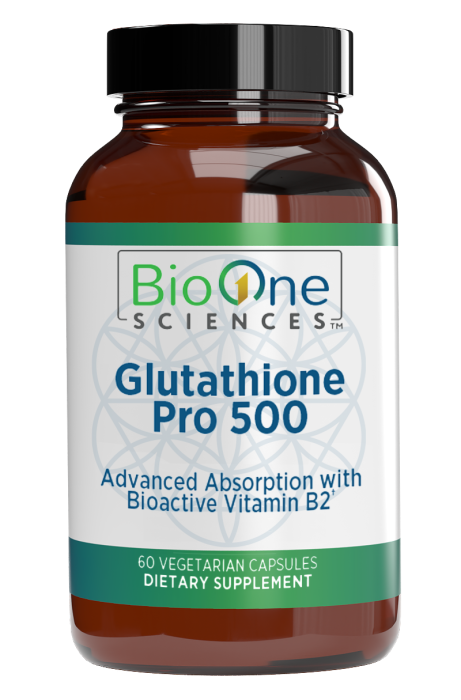
Glutathione Pro 500 from BioOne Sciences takes this a step further. Each serving provides a high-potency 500 mg dose of S-Acetyl L-Glutathione paired with Riboflavin 5’-Phosphate (R5P)—the active, coenzyme form of vitamin B2. R5P is essential for the enzyme glutathione reductase, which recycles oxidized glutathione back into its active, protective form. This synergy supports continuous antioxidant defense, enhanced detoxification, and efficient cellular repair.
This delayed-release vegetarian capsule protects the ingredients from stomach acid, ensuring optimal absorption in the intestines. The formula is also ideal for individuals experiencing oxidative stress, toxin exposure, or methylation challenges linked to common gene variants such as MTHFR, MTRR, and COMT.
By combining a highly bioavailable form of glutathione with a critical cofactor for regeneration, Glutathione Pro 500 supports:
Neutralization of mold toxins, heavy metals, plastics, and chemical pollutants
Protection of mitochondria and cellular DNA
Improved redox balance and antioxidant recycling
Support for immune, detox, and neurological health
1. https://www.ncbi.nlm.nih.gov/pmc/articles/PMC3099083/
2. https://www.atherosclerosis-journal.com/article/S0021-9150(07)00341-3/abstract
3. https://www.alzheimers.gov/clinical-trials/glutathione-alzheimers-disease
4. https://www.ncbi.nlm.nih.gov/pmc/articles/PMC3673338/
5. https://www.healthline.com/nutrition/how-to-increase-glutathione



(For established clients)
This appointment type should only be made for an established client. (After you have had your initial/first visit completed).
Not sure WHO to book with? No Problem! Here at MHH we have an AMAZING team of coaches and EVERY ONE OF OUR COACHES can help you with ANY of your conditions, so just pick the one that has availability on the day and time that works best for you.
This package contains 12 Biological Coaching Visits at 30 minutes each. Purchasing this package can save you 10% vs. if you purchased 12 sessions individually.
Using the combined modalities of EFT tapping, Resonance Repatterning, Color, Light, and Sound, this visit type addresses:
• Anxiety • Depression • Fear • Mind racing • Feelings of anger • Feelings of hopelessness • and more…
This unique approach can address and resolve emotional trauma, present or past, that has been locked into the physical body’s memory, often below the realm of conscious thought. Our bodies replay these memories at different times, and they can adversely affect our health especially in times of great stress and uncertainty.
These packages contain 12 Brain & Emotional Repatterning visits of 60 minutes or 90 minutes each. Purchasing either of these packages will save you 15% as compared to purchasing individual sessions
Not feeling well and looking for help with your condition, diagnosis, or symptoms that won’t go away no matter what you have tried? Our holistic biological health coaches can help you! Our coaches teach you how your body works, what the underlying cause of your condition or symptoms are, and how to fix and address them using long-term solutions that are data-driven and that work!
Our holistic biological health coaches have a deep understanding of advanced functional testing and genetics testing, along with much experience in complex cases.
Our biological coaching team works with you to empower and teach you how to understand and interpret your lab results, what your results mean, how they are connected to your health conditions or symptoms, and most importantly, what to do with the information, how to put protocols together based on your lab results, and when to reorder your various labs to track progress.
You will become your own healing master learning how to navigate the healing process, how to modify your protocols, when and how to detoxify your organs and cells from the toxins discovered on your lab results. You will learn the importance of tracking your assessment forms and symptom sheets and how to troubleshoot your healing process.
In addition, you have the opportunity to learn how to understand YOUR genetic blueprint – Our coaches are trained in the field of epigenetics and understand implicitly that YOU are in control of your own gene expression and how your genes either work for or against you. If you choose to add genetic testing into your program, your genetic blueprint information can be used not only to help drive your plan of action for healing, but also it can be used to understand your body’s unique nutrition, lifestyle, sleeping, eating, and physical activity needs are so that you can optimize once you are healed.
Get help from our functional nutrition coaches who understand that there is no ONE diet that is right for everyone. Our nutrition coaches work hand in hand with our biological coaches so if you need any lab work done or specific protocols that would require supplement protocols, you have a team working on your behalf and your nutrition coach would make recommendations for which other team coaches would be able to help you.
Your coaches will teach and empower you to learn how to determine and navigate your diet modifications which are decided based on your extensive intake forms, history, and your lab data that your coaches may want to order for you. Based on all of this information, they will teach you what foods to eat and not eat according to various conditions and why.
Your functional nutrition coach will help you learn what substitutes you can use when there are certain foods you may need to stop eating for a period of time, how to put your meals together based on your dietary needs per your lab data, how and when to incorporate gut repair protocols, and what lifestyle modifications you want to address based on your labs and your health conditions.
Nutritional coaching can be a great tool by itself or combined with coaching from our biological coaches. You can schedule with either our biological or nutrition coaches and they can help you get started and make recommendations as needed.
Many people who have successfully mentored with our nutrition coaches have had past issues such as:
Mindset, past and present traumas, and limiting belief systems are some of the biggest barriers to healing, so much in fact that gene expression and biological ‘engines’ of the human body can change for the worse because of it.
In the many years, we have been working in the field of holistic medicine, helping people who have tried everything else with no success or little success, we have discovered how great of an impact our thoughts, beliefs, and past and present trauma, and chronic stress can be to the human body, mind, and spirit.
The rate of recovery and healing for those who place emphasis on creating new neurological pathways to imprint new and healthy mindsets and belief systems in how they perceive themselves and the world around them is greatly improved when the psychological aspect of mindset and integration of mind, body, the spirit is addressed through repatterning of the mind and body neurology.
By removing barriers discovered from traumas, mindset, and conscious/unconscious patterns that are not congruent for healing, health, and vitality, you set yourself up for the best outcomes in your healing journey. Healing only occurs when the physical, emotional, and mental barriers to healing are removed.
Therefore we incorporate mind, body, spirit integration work into our programs and in doing so, we see exponential increases in positive outcomes with our clients. We have put together the most comprehensive ‘whole person’ approach in the world, and this is why our results are so successful.
Our Emotional Processing, Stress Release, & Neurological Repatterning coaches work with you to create new neurological connections, anchor new neurology, and habits, and show you how to become aware of any conscious or unconscious belief systems that may be holding you back from healing and total health.
You are welcome to try one or two appointments to see what you think. We typically recommend a minimum of 6 sessions to make an accurate assessment of how this type of modality is working for you.
Here are some of the modalities our Emotional Processing, Stress Release, & Neurological Repatterning coaches use for brain and body repatterning:
Breathwork is more than just a simple exercise of intentional breathing. Specialized breathwork techniques are used to facilitate major transformation and healing by encompassing a wide range of therapeutic practices that are extremely powerful in providing immediate relief for pulling people out of fight or flight (the amygdala hijack we teach about in Part 2 of our Mastering Trauma Masterclass).
This vagus nerve activation through breath work activates the rest/digest (parasympathetic nervous system), stimulates healing, reduces blood pressure, reduces the cortisol stress response, regulates hormone and blood glucose activity, and heart rate variability (the biological stress response). It rewires the body for self-regulation of the nervous system in a manner that optimizes the body and creates resilience in times of stress.
Yoga breath therapy allows you to disconnect from the mind chatter, mind racing, and negative self-talk and reconnect with your body your energy. From this elevated state of awareness, you are able to facilitate healing, growth, and expansion. And if you are looking for some expansion of your body/mind/spirit awareness, then this type of breathwork can be nourishing and can facilitate the next layer of peace, love, gratitude, connection, clarity, and insights.
In the many years, we have been working in the field of holistic medicine, helping people who have tried everything else with no success or little success, we have discovered how great of a damaging impact our thoughts, beliefs, and past and present trauma, and chronic stress (the fight or flight response) can be to the human body, mind, and spirit.
By becoming aware of how to regulate our own nervous system, and resolve traumas, mindset, and conscious/unconscious patterns that are not congruent for healing, health, and vitality, you set yourself up for the best outcomes in your healing journey. Healing only occurs when the physical, emotional, and mental barriers to healing are removed.
The rate of recovery and healing for those who place emphasis on:
….. Find much success and amplification in their healing journey.