
If you’ve been told your mental health symptoms are just something you’ll have to manage for the rest of your life, Melissa’s story might completely change what you think you know about psychiatric diagnoses.
Melissa was 43 when she came to work with us. By that point, she and her husband had already endured what they could only describe as a truly horrifying year. She’d been diagnosed with bipolar disorder and had been on medication for about a year. But what led to that diagnosis? It was far more terrifying than simple mood swings.
Before receiving her bipolar diagnosis, Melissa went through an episode where she didn’t sleep for an entire week. She experienced tingling throughout her whole body, especially in her arms and hands. Then she fell into a complete psychosis, becoming totally unaware of her own actions. Her husband watched, helpless, as she took eight showers in a row one evening, unaware; she even walked around the house without realizing she was naked.
Over nine months, Melissa was placed in solitary confinement and admitted to a mental hospital three times. The experience of being confined like that was deeply traumatic in itself.
But here’s the question that changed everything: What if Melissa’s “bipolar disorder” wasn’t actually a lifelong mental illness? What if it was her body’s desperate response to extreme levels of toxic chemicals and heavy metals that were literally damaging her brain?
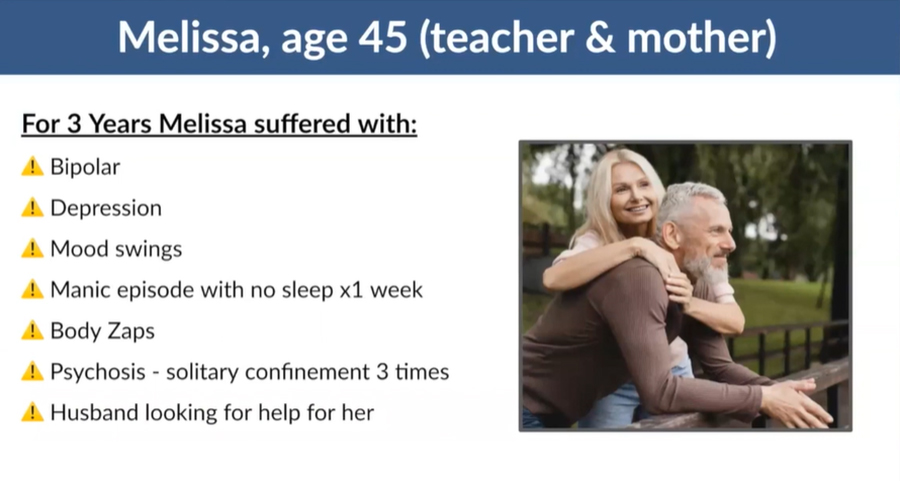
By the time Melissa found us, she’d been stable on medication for about a year. But here’s the thing—stable isn’t the same as healed. And Melissa knew it.
Looking at her initial symptom sheet, the aftermath of that horrifying year was written all over her body. She was dealing with headaches and really heavy bleeding during her periods. She had severe bloating and all the digestive issues that came with an inflamed gut. Her forgetfulness was significant enough that she was genuinely worried about her cognitive function. And then there was the stubborn weight around her midsection that wouldn’t budge no matter what she tried.
You could actually see the physical toll. Her thyroid was visibly swollen, and she had a red line across her neck—a classic sign of Hashimoto’s thyroiditis. Her gut was inflamed, causing constant symptoms.
But here’s what worried Melissa most: she understood the dangers of staying on psychiatric medications long term. She knew she needed to find out what was really driving all of this, not just mask the symptoms indefinitely.
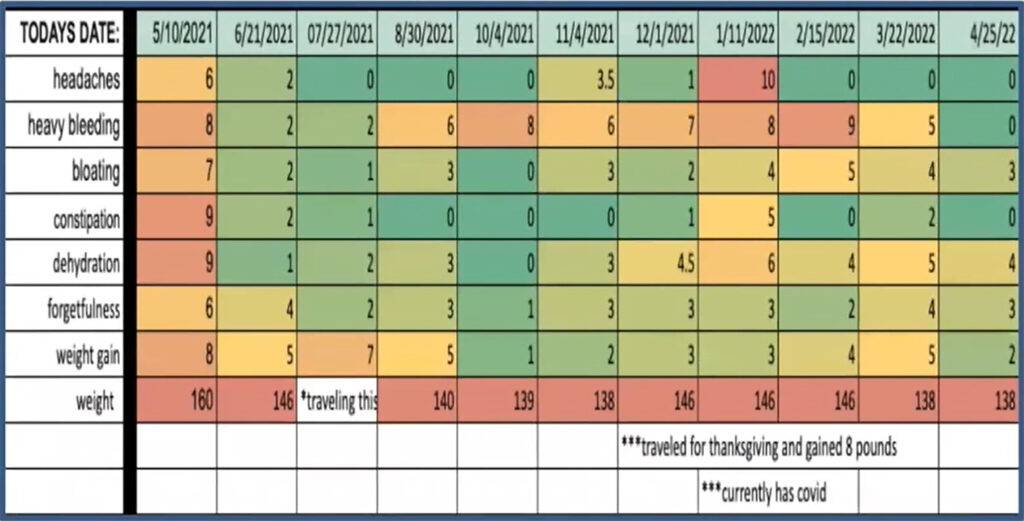
We ran comprehensive testing on Melissa, and what we found was staggering.
She had remarkably high levels of chemical toxins in her system. Perchlorate, a known contaminant in drinking water, and a neurotoxin called NAPR were at extremely high levels.
On top of those two toxins, she had a whole host of other chemical toxins that were in the moderate range. And here’s something important we tell our clients: just because a toxin level is in the “moderate range” doesn’t mean you should underestimate it, as it could still cause serious symptoms.
Overall, Melissa had a really high toxic load. Let’s look at what some of these specific toxins were doing to her body and brain:
Perchlorate is known for causing thyroid issues. Remember that visibly swollen thyroid and the red line across her neck? This was likely a major contributor.
DEDP is known for causing confusion, headaches, and disorientation—all of which she was experiencing during her episodes.
NAPR can lead to confusion, slurred speech, and difficulty walking. These were all symptoms she was experiencing.
DDA is an endocrine disruptor that messes with your hormones, which could explain the heavy bleeding and other hormonal issues.
DMP is associated with depression, memory problems, and confusion. Again, she was dealing with all of those.
Glyphosate was really high in her system, which can cause neurochemical imbalance (think psychiatric symptoms) and all the GI issues she was struggling with.
NAEE can cause neurological damage.
We were able to connect a lot of her symptoms—including the ones that led to her bipolar diagnosis—with the chemical toxins we found in her body.
Perhaps the biggest toxic overload Melissa experienced was extreme levels of palladium, a heavy metal.
This heavy metal is associated not only with neurological symptoms, conditions, and diseases (some of them very serious, as you can see), but also with damage to the bone marrow, kidneys, and liver. It’s considered carcinogenic, so cancer is not out of the question with palladium exposure.
Palladium can also cause skin, eye, and respiratory tract irritation, and it can trigger a lot of allergic reactions. We’re seeing more and more people developing severe chemical sensitivities to many things in their environment, and palladium exposure may be playing a role.
When we looked at Melissa’s lab results, her palladium reading was absolutely off the charts. Our tests stop measuring at 25, and even as she began detoxing, her levels stayed pinned at that maximum number for quite a while. Eventually, her levels did start to come down, and we were able to completely detox it from her body, but it took considerable time because the toxicity was so extreme.
Now, here’s what makes this even more significant. Look at the symptoms commonly associated with palladium toxicity: confusion, memory loss, insomnia, and depression. A lot of her symptoms—including the very ones that led to her bipolar diagnosis—aligned perfectly with palladium toxicity.

Once we identified Melissa’s extreme toxic burden, we could finally address what was really causing her symptoms.
We created a comprehensive detoxification protocol tailored specifically to Melissa’s test results. This wasn’t a generic “cleanse” or one-size-fits-all approach. We were targeting the specific toxins we’d identified in her body at the levels we’d measured.
We also addressed her thyroid issues, her gut inflammation, and her hormonal imbalances—all of which were connected to her toxic exposure.
Most importantly, we helped her understand that what she’d been experiencing wasn’t a lifelong mental illness she’d have to manage forever. It was her body’s response to extreme poisoning. And poisoning can be reversed.
The results speak for themselves.
As Melissa went through our detox protocols and addressed all the root causes of her symptoms, everything began to change. The woman who had been placed in solitary confinement three times, who had experienced full psychosis, who couldn’t sleep for a week straight—that same woman was now stable, clear-minded, and healing.
Her cognitive function improved. The forgetfulness that had worried her so much began to fade. Her gut inflammation decreased, and with it, all those digestive symptoms started resolving. The resistant weight she couldn’t lose before? It started coming off as her body was finally able to detoxify and her hormones rebalanced.
Her thyroid began to heal. That visible swelling and the red line across her neck—classic signs of thyroid dysfunction—improved as we addressed perchlorate and other toxins that were attacking her thyroid.
Most remarkably, as the toxins left her system, the psychiatric symptoms that had led to her bipolar diagnosis resolved. She didn’t need to be on psychiatric medication for the rest of her life because she had never had a psychiatric disorder requiring lifelong treatment. She’d had extreme toxic poisoning that was causing neurological damage and psychiatric symptoms.
1. Psychiatric symptoms can have physical, measurable causes
Melissa’s confusion, memory loss, insomnia, depression, and even her psychotic episode weren’t mysterious mental health conditions. They were direct results of specific toxins in her body—toxins we could measure, identify, and remove. When you’re told you have a mental illness, have you been tested for toxic exposure? Have you been tested for heavy metals like palladium that are known to cause the exact symptoms you’re experiencing?
2. A bipolar diagnosis doesn’t always mean bipolar disorder
Melissa was diagnosed with bipolar disorder based on her symptoms. And to be fair, her symptoms looked like bipolar disorder from the outside. But the diagnosis was treating the symptom picture, not investigating the root cause. Once we found and removed the extreme levels of toxins—especially the off-the-charts palladium—those “bipolar” symptoms resolved. The diagnosis had been based on symptoms that were actually toxicity.
3. Environmental toxins can cause severe psychiatric symptoms
Most people don’t realize that chemicals like perchlorate, NAPR, and DEDP, and heavy metals like palladium, can cause confusion, psychosis, depression, insomnia, and other serious psychiatric symptoms. These aren’t minor side effects. These are profound neurological impacts that can completely alter your mental state and behavior. If you’re struggling with psychiatric symptoms, environmental toxic exposure should be investigated.
4. “Moderate” levels of toxins can still cause severe symptoms
Melissa had some toxins at “moderate” levels and others at extreme levels. But even those moderate-range toxins were contributing to her symptoms. Don’t underestimate what even moderate toxic exposure can do, especially when you have multiple toxins creating a cumulative burden on your body. It all adds up.
5. You can be stable on medication and still not be healing
Melissa was stable when she came to us. The medication was managing her symptoms. But she wasn’t healing. Her body was still toxic. Her thyroid was still swollen. Her gut was still inflamed. Stability isn’t the same as health. And she knew that staying on those medications long-term came with its own risks. Real healing meant finding and addressing the root cause.
6. Palladium toxicity is becoming more common—and it’s dangerous
We’re seeing palladium show up in more and more people at really high levels. This heavy metal can cause serious neurological symptoms, damage your organs, and is carcinogenic. If you’re developing chemical sensitivities, unexplained neurological symptoms, or psychiatric symptoms that don’t respond well to treatment, palladium exposure should be investigated. This is an emerging issue that’s flying under the radar of conventional medicine.
7. The trauma of psychiatric hospitalization is real—and sometimes preventable
Being placed in solitary confinement and admitted to a mental hospital three times was deeply traumatic for Melissa. That experience left its own scars. But what if that trauma could have been prevented by testing for and treating toxic exposure in the first place? How many people are being hospitalized and traumatized by a mental health system that isn’t looking for the physical root causes of psychiatric symptoms?
Maybe you’re reading Melissa’s story and something is clicking for you. Maybe you’ve been diagnosed with a psychiatric condition—bipolar disorder, depression, anxiety—and the medications help somewhat, but you’re not actually getting better. Maybe you have unexplained neurological symptoms, cognitive issues, or physical symptoms alongside your mental health struggles that don’t seem connected.
Or maybe you’re developing chemical sensitivities, struggling with thyroid issues, dealing with gut problems, or experiencing symptoms that doctors can’t quite explain or effectively treat.
If any of that sounds familiar, here’s what you need to know: toxic exposure—whether it’s mold, environmental chemicals, or heavy metals—can cause psychiatric symptoms, neurological damage, and chronic illness. And these toxins can be measured, identified, and removed from your body.
Melissa’s “bipolar disorder” wasn’t a lifelong sentence. It was poisoning. And when we removed the poison, the symptoms resolved.
You don’t have to just manage your symptoms forever. You can investigate and address what’s actually causing them.




What is the primary goal of this appointment?
Focus on physical symptoms, lab tests, gut health, toxins, and targeted nutrition protocols.
Focus on mental wellness, trauma processing, stress management, and cognitive support.
What is the primary goal of this appointment?
Focus on physical symptoms, lab tests, gut health, toxins, and targeted nutrition protocols.
Focus on mental wellness, trauma processing, stress management, and cognitive support.